

▲ ☰

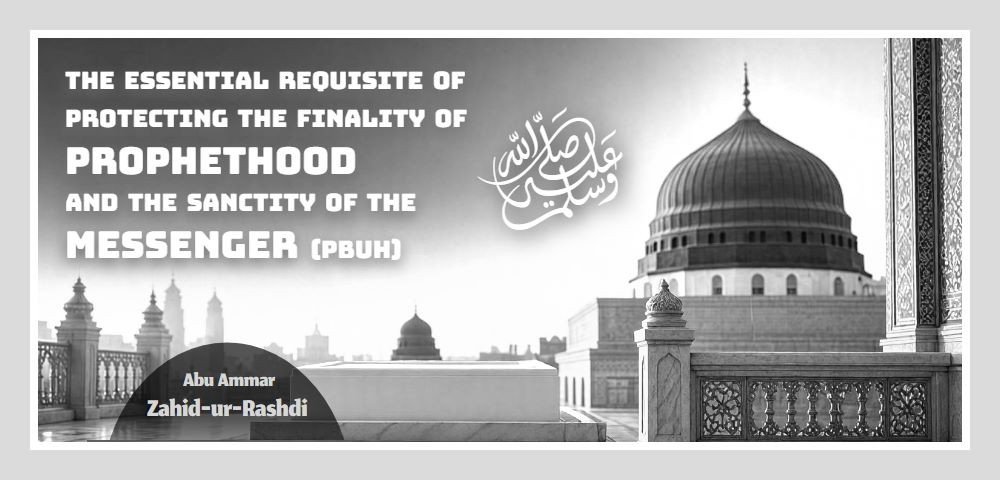
The Essential Requisite of Protecting the Finality of Prophethood and the Sanctity of the Messenger (PBUH)
Every year on the seventh of September, "Yaum-e-Khatm-e-Nubuwwat" (Day of the Finality of Prophethood) is observed across the country. On this occasion, gatherings are held, processions are taken out, the historic decision of Parliament regarding Qadianis on 7 September 1974 is recalled, and while paying tribute to the leaders and segments who made that decision, the demands and requirements of the Khatm-e-Nubuwwat movement are reiterated.
When Mirza Ghulam Ahmad Qadiani, in the environment of British domination after the 1857 War of Independence, proclaimed prophethood, then:
  1. The very first task was that of the scholars of Islam, which they performed excellently — that is, the leading scholars of all schools of thought, under the leadership of Allama Syed Muhammad Anwar Shah Kashmiri (RA), Hazrat Pir Mehr Ali Shah Golravi (RA), Hazrat Maulana Sanaullah Amritsari (RA), and Maulana Mazhar Ali Azhar (RA), declared Mirza Ghulam Ahmad Qadiani and his followers outside the fold of Islam due to the claim of new prophethood and new revelation and other blasphemous beliefs, and declared them a new religion and community separate from the Muslim Ummah. And the entire Muslim Ummah agreed upon this decision of the scholars.
  2. In the second stage, from the side of those possessing modern thought, knowledge, and education, the Thinker of Pakistan, Allama Muhammad Iqbal (RA), announced the same position, declaring it the agreed-upon stance and belief of both the old and new classes, and demanded from the then British government that instead of counting Qadianis alongside Muslims, they should be given the status of a separate and non-Muslim community.
  3. The third stage was to determine the political and social status of Qadianis settled in Pakistan after the establishment of Pakistan. On this, the leading scholars of all schools of thought once again gathered, and Maulana Syed Abul Hasanat Qadri (RA), Amir e Shariat Syed Ataullah Shah Bukhari (RA), Maulana Syed Abul A'la Maududi (RA), Maulana Syed Muhammad Daud Ghaznavi (RA), Maulana Ahmad Ali Lahori (RA), Maulana Mufti Jafar Hussain (RA), and other leading scholars jointly demanded from the government that instead of counting Qadianis alongside Muslims in Pakistan, they should be given the status of a separate and non-Muslim minority in the constitution and law. On this, a countrywide movement was launched in 1953, thousands of people drank the cup of martyrdom, and thousands went to prisons — among whom, besides scholars and religious workers, the business community, the legal community, leaders of political parties, and other segments were also included. This gave the demand the status of a national demand and requirement. This movement continued continuously, and in 1974, Parliament, through unanimously passed constitutional amendments, included Qadianis in the list of non-Muslim minorities.
During this period, cases regarding this issue continued to come under discussion in courts at every level, and ultimately the Supreme Court of Pakistan also affixed its seal of confirmation on Qadianis being a non-Muslim minority. Apparently, this movement reached its logical conclusion, but Qadianis refused to accept this decision and:
  1. On the one hand, they boycotted every stage of implementation of this decision within the country — for example, they refused to count themselves as non-Muslims in the census, and besides this, they also boycotted the elections for the seats reserved for Qadianis in the national and provincial assemblies, which continues to this day, and there is a continuous obstruction in the implementation of these decisions of Parliament and the Supreme Court.
  2. While on the other hand, Qadianis turned to international institutions and, declaring the decisions and laws made regarding Qadianism in Pakistan to be a violation of international human rights agreements, beat the drum of their victimhood and deprivation. On this, many international forums and lobbies came out in their support, and this debate continues to this day in various international institutions and forums, and its scope is continually expanding.
Consequently, that scholarly, legal, and political struggle — which had been ongoing for a century within the region in public gatherings, elected institutions, courts, and forums, after this decision — became a subject of international institutions, international agreements, and intervention by external forces in Pakistan's internal affairs. Today's situation is that in scholarly debates, public gatherings, legal and constitutional institutions, and the political environment, on the front of scholars, religious and political parties, forums of the legal and business communities, and public opinion, this decision holds the status of an agreed-upon national position, and demands are being made for its implementation — but in international institutions and circles, there is no environment to confront the ongoing proceedings against this decision, due to which external pressure is continually increasing.
As a worker of the Khatm-e-Nubuwwat movement, my respectful request has been going out to all circles that leaving this front empty for Qadianis is not right. The decision to declare Qadianis a non-Muslim minority is a national decision, and defending it is our national duty. And we did do so on one occasion — that when this issue was presented in the Supreme Court of South Africa, the Government of Pakistan sent a delegation to it, which included leading scholars who presented Pakistan's position in the Supreme Court of South Africa, as a result of which the court's decision came in favor of Muslims. Besides this, I do not recall that any official delegation from Pakistan went to any international forum on this issue and took the trouble to present Pakistan's position.
Along with this, the law for the protection of the sanctity of Prophethood (PBUH) and the death penalty for the blasphemer of the Prophet (PBUH) is also under discussion in international institutions in the same way, and there is a continuous demand being made to the Government of Pakistan to abolish both these laws, and rather external pressure is increasing for this. In this background, I want to submit that regarding both these laws — the protection of Khatm-e-Nubuwwat and the protection of the sanctity of Prophethood — we should participate in the discussion taking place in international institutions in the same way as we appeared in the Supreme Court of South Africa and succeeded in clarifying our position and obtaining a correct decision. For this, there are four stages and circles in my mind that are worthy of attention from all of us:
  1. The first circle is that this issue is one of the consensus belief and position of the Muslim Ummah, therefore the representative body of Muslim governments, the "Organisation of Islamic Cooperation" (OIC), should come forward and pursue this case. If it is not prepared for this, then it is the responsibility of the "Rabita Alam-e-Islami" (Muslim World League), as it is a recognized international institution of Muslims and it was the first at the global level to announce Qadianis as a non-Muslim minority, therefore this case should be taken in hand by the "Rabita Alam-e-Islami." While besides this, there is also an international organization of Muslims under the title "Motamar Alam-e-Islami" (World Muslim Congress); if it also declares this case as its own case, then it can do so.
  2. In the second stage, since both the laws concerning Qadianism and the sanctity of Prophethood (PBUH) are enforced in Pakistan and it is on their basis that the campaign is run, therefore the Government of Pakistan should itself become a party in these cases. In the era when respected Sahibzada Noor-ul-Haq Qadri was Federal Minister for Religious Affairs, we appeared before him with a delegation of the Pakistan Shariat Council and formally requested that, regarding Khatm-e-Nubuwwat and the sanctity of Prophethood, in the discussions and disputes taking place in international institutions, Pakistan is discussed as a state, therefore the Government of Pakistan should come forward in defense of its country and constitution, and a permanent department of the Federal Ministry of Religious Affairs should be established which, with the assistance of leading scholars and legal experts, defends the country in these cases.
  3. In the third stage, it is the responsibility of the religious parties working under the title of protection of Khatm-e-Nubuwwat and protection of the sanctity of Prophethood that if no one else is serious about participating in these cases, then they should, by forming some organization of their own, individually or jointly, pursue Qadiani activities in international institutions and forums regarding both these laws; and arrange to present their position themselves in these institutions.
  4. While in the fourth stage, Pakistanis residing in Western countries, especially America and Europe, should form NGOs within the scope of the environment and facilities there. If NGOs of Western countries can work in our countries, why can't our NGOs work there? Therefore, Muslims living there, especially Pakistanis, should, in an organized manner, arrange for the defense and protection of their belief regarding the protection of Khatm-e-Nubuwwat and the protection of the sanctity of Prophethood and other religious matters — this would be the greatest requirement of the time and a religious and national service. May Allah Almighty grant us the ability to do so, Ameen Ya Rabb-ul-Alameen.

Translations

(الشریعہ — اکتوبر ۲۰۲۶ء)

الشریعہ — اکتوبر ۲۰۲۶ء

جلد ۳۷ ، شمارہ ۱۰

’’خطباتِ فتحیہ: احکام القرآن اور عصرِ حاضر‘‘ (۱۶)
مولانا ابوعمار زاہد الراشدی
مولانا ڈاکٹر محمد سعید عاطف

علامہ آلوسی کی تفسیر ’’روح المعانی‘‘
مفتی شاد محمد شاد

امتِ مسلمہ کی تعمیر و تشکیل کا نبوی منہج (۳)
مولانا ڈاکٹر محمد ابوبکر فاروقی

کیا قدیم علمِ کلام دورِ حاضر میں ایک  غیر متعلق روایت بن چکا ہے؟ (۱۰)
ڈاکٹر مفتی ذبیح اللہ مجددی

’’اسلام اور ارتقا: الغزالی اور جدید ارتقائی نظریات‘‘ کا جائزہ (۱۸)
ڈاکٹر شعیب احمد ملک
محمد یونس قاسمی

اصحابِ محمدؐ رضوان اللہ علیہم اجمعین کی حیات و خدمات ( ۶)
محمد سراج اسرار

سیاست نامہ از نظام الملک طوسی
ڈاکٹر محمد اکرم ندوی
ڈاکٹر فضل الرحمٰن محمود

استشارہ اور استخارہ: اہمیت، فضیلت اور طریقہ کار
مولانا عبد المتین

جزیرۃ العرب میں غیر مسلموں کی رہائش کی ممانعت کا شرعی و عقلی جائزہ
مفتی سید انور شاہ

اسلام کا سیاسی نظام: ایک قانونی تجزیہ (۱)
ڈاکٹر محمد مشتاق احمد

اسلام اور شخصی آزادی (۲)
ڈاکٹر محمد عمار خان ناصر
ذیشان ہاشم

The Essential Requisite of Protecting the Finality of Prophethood and the Sanctity of the Messenger (PBUH)
Abu Ammar Zahid-ur-Rashdi

مولانا عبید اللہ سندھی سے منسوب ایک مقالے کی تحقیق
مولانا صدیق احمد فاروق

نفاذِ شریعت یا سیکولرزم
حسنین خالد

قائد اعظم اور قانونِ وقف الاولاد
پروفیسر محبوب پوپاتیا

Our Constitutional History & Background of the Proposed 28th Amendment
Mufti Munib ur Rehman

یمن: تابناک ماضی سے مخدوش مستقبل تک
ڈاکٹر محمد غطریف شہباز ندوی

کیا چین مسلم اُمت کا اتحادی بننے جا رہا ہے؟
خالد محمود عباسی

Some Points for the Iranian Leadership`s Consideration
Abu Ammar Zahid-ur-Rashdi

دارالعلوم کراچی میں منعقدہ ایک مبارک تقریب کا احوال
مولانا حافظ خرم شہزاد
تلاش

شماریات