

▲ ☰

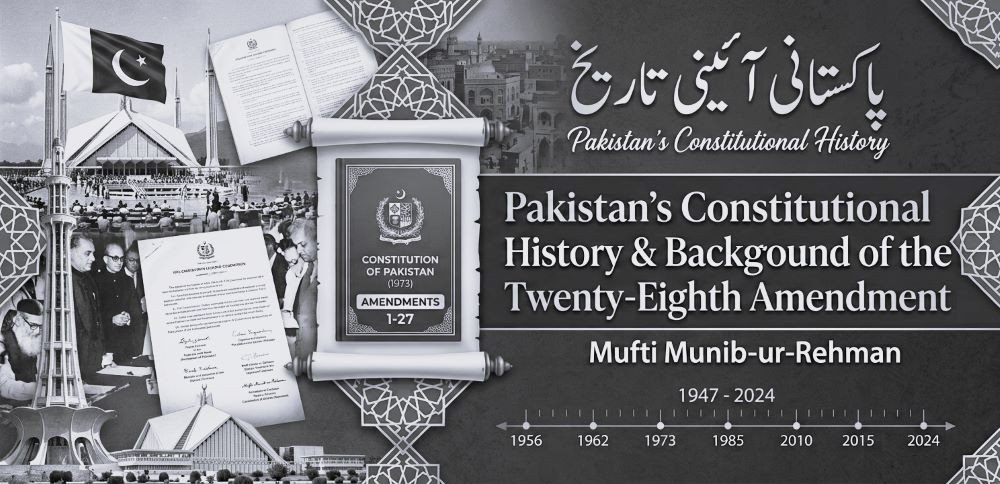
Our Constitutional History & Background of the Proposed 28th Amendment

Pakistan's constitutional history is not particularly glorious. After 14 August 1947, Pakistan continued to be governed under the Government of India Act 1935 with minor amendments, and the founder of Pakistan, Quaid-e-Azam Muhammad Ali Jinnah, was appointed Pakistan's first Governor-General. Elections for Pakistan's first Constituent Assembly were held in July 1947. These representatives were not directly elected; rather, members of the assemblies of East Bengal, West Punjab, Sindh, the Frontier, and Balochistan indirectly elected 69 individuals. The inaugural session of the first Constituent Assembly was held on 10 August 1947 in Karachi at the Sindh Assembly building under the chairmanship of Quaid-e-Azam Muhammad Ali Jinnah. This Assembly functioned from 1947 to 1954.
Elections for the second Constituent Assembly, comprising three hundred members, were held on 21 June 1955, and in this Assembly a constitution based on the principle of equal representation between West and East Pakistan was approved on 29 February 1956. Under it, West Pakistan was made a single unit and given the status of a province, but elections could not be held under this constitution.
On 7 October 1958, the Commander-in-Chief of the Army, General Muhammad Ayub Khan, imposed martial law and, becoming President and Chief Martial Law Administrator, took control of the country. Then on 14 February 1960, Field Marshal Muhammad Ayub Khan got his presidency confirmed through a referendum. After that, on 1 March 1962, a constitution based on the system of Basic Democracies was approved, and on 8 June martial law was lifted and this constitution was fully enforced; this constitution was based on a presidential system. Under the 1962 constitution, the second election was held on 2 January 1965, and defeating the Madar-e-Millat Mohtarma Fatima Jinnah, Field Marshal Muhammad Ayub Khan was elected President of Pakistan.
On 25 March 1969, President Ayub Khan, in negation of his own constitution, instead of handing over power to the Speaker of the National Assembly, handed it over to Commander-in-Chief General Agha Muhammad Yahya Khan, who, becoming President of Pakistan and Chief Martial Law Administrator, seized power. Then General Yahya Khan announced a legal framework on 30 March 1970 on the principle of one person, one vote, and drew up a program for elections to a Constituent Assembly comprising 313 members. In it, 169 and 144 seats were allocated for East and West Pakistan respectively. In June 1970, elections were announced, but due to floods in East Pakistan these elections were postponed. Then on 7 December 1970 elections for the National Assembly and on 17 December for the provincial assemblies were held. Sheikh Mujibur Rahman's Awami League won 167 of the 169 seats in East Pakistan; besides this, only Nurul Amin on the PDP ticket and independent candidate Raja Tridiv Roy were able to win. While in West Pakistan, the Peoples Party received a heavy majority in Sindh and Punjab, and including women's seats, their members numbered approximately 85. General Yahya Khan, contrary to democratic traditions, did not transfer power to Sheikh Mujibur Rahman; then a rebellion began there, and ultimately on 16 December 1971 the Fall of Dhaka occurred, and as a result Bangladesh came into existence.
Then General Yahya Khan, compelled by circumstances, transferred power to Mr. Zulfikar Ali Bhutto, and he became the first civilian Chief Martial Law Administrator and President. Later, on 17 April 1972, the late Zulfikar Ali Bhutto enforced an interim constitution and, ending martial law, himself assumed the office of President of Pakistan. After that, on 10 April 1973, a consensus constitution based on a parliamentary system was approved. On this constitution, besides Nawab Khair Bakhsh Marri and Dr. Abdul Hayee Baloch from Balochistan and Nizamuddin Haider and Noor Muhammad Hashimi from Punjab, the confirming signatures of all members of the National Assembly are recorded.
Since then, in the 53 years up to now, 27 amendments have been made to this constitution, although in the American constitution only 27 amendments have been made over a period of two and a half centuries. Circles close to the establishment from time to time keep giving the 'good news' that behind the scenes preparations for the twenty-eighth amendment to the constitution have begun, and one of its objectives is also to alter the NFC Award and make it balanced, and by reducing the provinces' share from the central pool of revenues and increasing the federation's share, so that the federation's financial position may improve somewhat, because its financial responsibilities include defense, installment payments on internal and external loans along with interest, protection of internal security, as well as dealing with separatism and terrorist activities, while in the current situation heavy expenditures are falling on the federation. In short, on the strength of the arguments the federation has a strong case, but what is at stake here are the (provinces') interests.
The Eighteenth Amendment is disliked by the establishment because under it fifty-seven and a half percent of total federal revenues goes to the provinces and the federation's hands are tied. Apart from installments on internal and external loans including interest and defense, running the federal structure is practically impossible without further and further borrowing, because the federation also has to make payments for Gilgit-Baltistan, Azad Kashmir, and the merged tribal districts in Khyber Pakhtunkhwa.
So through the proposed Twenty-Eighth Amendment, a restructuring of the NFC Award is desired. It is also desired that funds be transferred directly from the federation to new administrative units so that the provinces' monopoly may end. In short, the transfer of political and administrative power, financial resources, and authority to the lower level—that is, deconcentration of power—is desired. In the planners' view, this will strengthen the federation and give the people governance that is accessible down to the lower level. This Pandora's box has been opened; certainly behind the scenes its preparation must have been underway for a long time, however, to strengthen the case, statistics have also been compiled and their first glimpse has also been shown.
A constitution provides a framework of rights and duties for a nation to remain united. This constitution is a covenant for a nation to remain united within the bounds of constitution and law. Nowadays it is interpreted as a Social Contract. It is very difficult to bring the country's different provinces, nationalities, and classes together on one covenant, therefore in the eyes of sensitive, conscientious, and constitution- and law-abiding individuals, protection of the constitution is essential, because day after day cutting and slashing it and deleting from and adding to it causes difficulties, and then a time comes when the constitution becomes a child's plaything.
In our history the constitution has repeatedly been abrogated and suspended: first in 1958, second in 1969, third in 1977, and fourth in 1999. The judiciary's assistance was also included in this, and it was named the doctrine of necessity.
  • General Yahya Khan's unconstitutional actions were given protection in the 1973 constitution.
  • General Muhammad Zia-ul-Haq was given the power to amend the constitution by the Supreme Court under the leadership of the then Chief Justice Anwarul Haq. Using that power, he made amendments to the constitution, and then the non-party National Assembly elected in 1985, through the Eighth Constitutional Amendment, confirmed his unconstitutional actions.
  • Similarly, General Pervez Musharraf, becoming Chief Executive, seized power. He was given the power by the Supreme Court under the leadership of Justice Irshad Hasan Khan to remain ruler for three years and to amend the constitution. General Musharraf's unconstitutional actions were once again validated by the elected parliament of 2002 through the Seventeenth Constitutional Amendment.
Such legal drafts are interpreted as an Indemnity Bill. So every unconstitutional action had to be given protection by every incoming assembly or parliament compelled by circumstances, because their own survival was also linked to it.
(Daily Dunya — 12 September 2026)

Translations

(الشریعہ — اکتوبر ۲۰۲۶ء)

الشریعہ — اکتوبر ۲۰۲۶ء

جلد ۳۷ ، شمارہ ۱۰

’’خطباتِ فتحیہ: احکام القرآن اور عصرِ حاضر‘‘ (۱۶)
مولانا ابوعمار زاہد الراشدی
مولانا ڈاکٹر محمد سعید عاطف

علامہ آلوسی کی تفسیر ’’روح المعانی‘‘
مفتی شاد محمد شاد

امتِ مسلمہ کی تعمیر و تشکیل کا نبوی منہج (۳)
مولانا ڈاکٹر محمد ابوبکر فاروقی

کیا قدیم علمِ کلام دورِ حاضر میں ایک  غیر متعلق روایت بن چکا ہے؟ (۱۰)
ڈاکٹر مفتی ذبیح اللہ مجددی

’’اسلام اور ارتقا: الغزالی اور جدید ارتقائی نظریات‘‘ کا جائزہ (۱۸)
ڈاکٹر شعیب احمد ملک
محمد یونس قاسمی

اصحابِ محمدؐ رضوان اللہ علیہم اجمعین کی حیات و خدمات ( ۶)
محمد سراج اسرار

سیاست نامہ از نظام الملک طوسی
ڈاکٹر محمد اکرم ندوی
ڈاکٹر فضل الرحمٰن محمود

استشارہ اور استخارہ: اہمیت، فضیلت اور طریقہ کار
مولانا عبد المتین

جزیرۃ العرب میں غیر مسلموں کی رہائش کی ممانعت کا شرعی و عقلی جائزہ
مفتی سید انور شاہ

اسلام کا سیاسی نظام: ایک قانونی تجزیہ (۱)
ڈاکٹر محمد مشتاق احمد

اسلام اور شخصی آزادی (۲)
ڈاکٹر محمد عمار خان ناصر
ذیشان ہاشم

The Essential Requisite of Protecting the Finality of Prophethood and the Sanctity of the Messenger (PBUH)
Abu Ammar Zahid-ur-Rashdi

مولانا عبید اللہ سندھی سے منسوب ایک مقالے کی تحقیق
مولانا صدیق احمد فاروق

نفاذِ شریعت یا سیکولرزم
حسنین خالد

قائد اعظم اور قانونِ وقف الاولاد
پروفیسر محبوب پوپاتیا

Our Constitutional History & Background of the Proposed 28th Amendment
Mufti Munib ur Rehman

یمن: تابناک ماضی سے مخدوش مستقبل تک
ڈاکٹر محمد غطریف شہباز ندوی

کیا چین مسلم اُمت کا اتحادی بننے جا رہا ہے؟
خالد محمود عباسی

Some Points for the Iranian Leadership`s Consideration
Abu Ammar Zahid-ur-Rashdi

دارالعلوم کراچی میں منعقدہ ایک مبارک تقریب کا احوال
مولانا حافظ خرم شہزاد

تلاش

شماریات