Pakistan and the Muslim World: Where We Stand, Where We Go
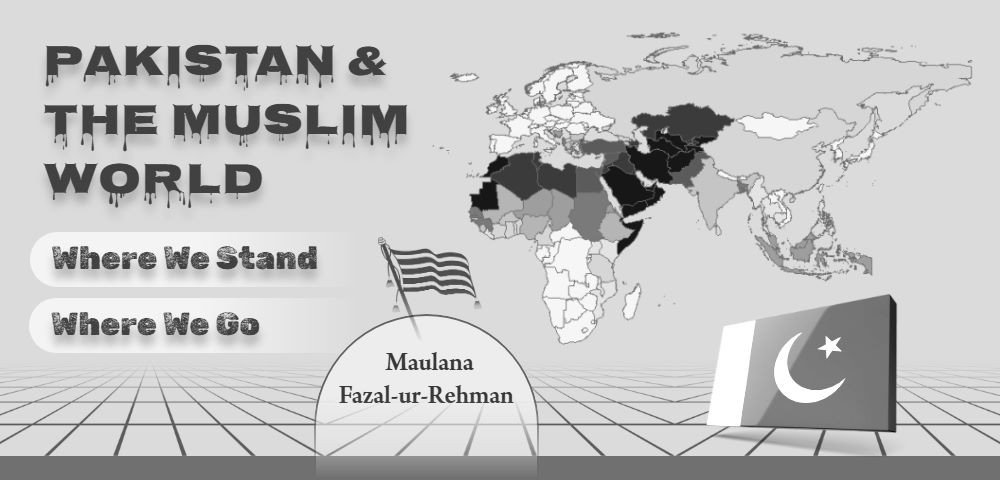
This article presents the thoughts Maulana Fazlur Rehman shared with journalists in a press conference held in Dera Ismail Khan on 27 March 2026, taken from his opening speech and the questions that followed.
I thank you for giving me this opportunity through this press conference, and after a long period of time, we are once again gathered here in Dera Ismail Khan.
Pakistan’s Law and Order Situation
Certainly, the most sensitive issue here is the law and order situation. Whether it is Tank, Waziristan, Dera Ismail Khan, Lakki Marwat, or Bannu — the rural areas are being emptied, and settled people are migrating away because their lives are not safe, and the writ of the government is nowhere to be seen.
Then, where the government appears unable to deal with this entire situation, Pakistan has become entangled in war on both the eastern and western borders, which has left the country besieged. China is also not satisfied with Pakistan; we have caused great harm to China's investment within Pakistan and have damaged its trust. Iran is also not in a position to be of any help to Pakistan or to conduct any trade or dealings with us.
Therefore, in my view, this is no longer a matter for any single party — that we can simply criticize and consider ourselves absolved of responsibility, or hold any one party responsible. This is a national issue. And we have already proposed on the floor of Parliament that there should be an in-camera session of Parliament, in which this representative institution of the people should be informed of the situation, where Pakistan stands should be made clear, and then, through national consultation, a way out of this difficulty should be found.
Whether it is the Peoples Party, the Muslim League-N, or the MQM, they all claim that this is our government and a coalition government. Although sometimes reservations arise in between, they call it their shared government. Why today, in the presence of the military leadership, a joint sitting of the leaderships of both parties became necessary? I think this is not enough. This is again giving further signals — perhaps matters will move more toward negative signals. The need is that the entire Parliament should be taken into confidence. And just as the Prime Minister had given us hope that he would consider it and then decide, but so far he has not come into a position to decide. We must decide on this quickly.
Afghanistan is More Than a Government
Regarding Afghanistan, there are two conflicting narratives in Pakistan. The KP government says one thing on one side, and federal government statements are different. Why have we not been able to formulate a clear Afghanistan policy for seventy years? What would I advise? Until this "worm" does not leave our minds — that we have to keep Afghanistan subjugated, and that no government in Afghanistan will run without our consent — until then, matters cannot be set right. We must focus on an independent Afghanistan, a sovereign Afghanistan, an autonomous Afghanistan. And our past sacrifices in this regard must be brought to some successful conclusion. We believe that our diplomatic efforts of seventy or seventy-eight years in Afghanistan — why have they failed so far? This is a persistent question. It is not enough to say: "We tried hard and the Afghans don't agree; we tried hard and the Afghans don't agree." That is not the issue. The issue is: why don't they agree? Are all the mistakes of seventy years on their side? And is there absolutely no mistake on our side? This too we must think about at the national level.
Afghanistan is not just the name of a government. Afghanistan is not just the name of the Islamic Emirate there. Afghanistan is also the name of its people, the name of the Afghan nation. The Afghan nation has ties with us, has relations with us, their tribes are shared with us, and their way of life is shared with us. Keeping all these relations in view, we must think about Afghanistan. This constant talk of regime change, regime change, regime change — this will perhaps become an endless series. We supported the revolution against Zahir Shah. Then after that came the communist revolution, then we waged jihad against them — when America came at that time, we joined too. Then it was the same America that switched sides, so in Musharraf's time we were again fighting America's war. Today we are once again acting according to America's wishes.
For the resolution of the Pak-Afghan conflict, I appear to be in favor of negotiations. Before the question of whether or not to negotiate with them, we must see what is the obstacle between Afghan-Pakistan relations. Whether we make it a direct part of negotiations or not, it will have to be addressed; without addressing it, Afghan-Pakistan relations will perhaps face difficulties in returning to normal. So, at what level this is addressed is itself a separate question.
Pakistan and the Muslim World
Pakistan today — Pakistan versus India, Pakistan versus Afghanistan, Pakistan-China relations, Pakistan-America relations, where does Pakistan stand regarding Israel, where does Pakistan stand on the Palestine issue, we have relations with Arab countries, where do the Arabs stand today, where do we stand? In this entire international and regional situation, we must clarify our country's position. We are heading into very ambiguous circumstances, and we are not in a position to adopt any clear policy.
So, there too, our thinking is that whether it is a century of Arab history or fifty years of it — the way they made their politics, their economy, and their diplomacy dependent on America and the Western world; and the way, in the name of security and the prospect of security, we gave bases to America and Europe, handed over the seas to them, their naval fleets are stationed everywhere, with the idea that these would become a source of peace and security for this region — today they have become a source of insecurity there.
What has the Islamic world gained? In Afghanistan, continuous war and war for fifty-five years, and international powers intervening in Afghanistan. What happened to Iraq? What happened to Libya? What is happening with Iran today? One by one, isolating each and bringing the Muslim world up against them — the results with which we are being led today, the Islamic community must rethink this. There should be an Islamic conference, and past international relations must be reviewed. We must move toward an Islamic bloc — political relations among the Islamic world, economic relations among the Islamic world, trade links, and defense agreements among the Islamic world — we must move in that direction.
Our mutual divisions — at least now the Islamic world is coming to understand, because since the war with Iran began, in the Arab world, despite attacks on American or European bases there, the Arab world and the Islamic world are showing restraint; they do not want to become part of the war; they are not taking it emotionally. This is a change in the thinking of the Islamic world at the international level. And this should become the foundation for us to think about the future regarding the Islamic world, regarding the Muslim community, regarding the interests of the Islamic world, and to find common ground in our interests and adopt a joint strategy for it.
This is our message at this time — for the Islamic world, for Pakistan, for the Pakistani state — and that the demands of the situation must be understood. Making decisions in closed rooms, keeping the people uninformed, having dissatisfaction among the people — this is perhaps not a good thing. We must take the people into confidence at every level.
In the past, during Bhutto's era and King Faisal's era, a unity was formed, a summit conference was called. We have seen its results — that then they were picked off one by one and made an example. So can we now bear to unite everyone again? In my view, the situation is not the same now. America is no longer a superpower; it is doing all this to maintain a facade. Rather, it is even being said that perhaps Trump is doing all this for his own personal defense, not even for America's defense. And there, America does not have public support at this time. The big question is that the person who contested the election saying he would end wars in the world has, upon coming to power, imposed war on the world. This is a question mark in the eyes of Americans and the American public themselves.
So, at this time, the whole world is rethinking. And obviously, after the breakup of the Soviet Union, we have been saying from the beginning that global change and transformations will come. So at this time, the whole world — from America to Russia to China — is under the impact of global transformations. And we must sit ourselves and, with self-confidence, carve out our own future.
Pakistan's Role in the Iran-Israel-America War
We are seeing that in the Iran-Israel-American war, Pakistan's role is unclear. Although there is talk of mediation as well. This is the same question — that at this time there is talk of mediation; is Pakistan in a position to mediate? And the fact that Trump tweeted in response to a tweet by a ruler like Shehbaz Sharif is itself a reflection of Trump's weakness and the weakness of American policy. So, we must think about this. Pakistan is, after all, under siege, and other than a mediatory role, what other path do we have?
This war that is ongoing, and in which they have closed the Strait of Hormuz, has put America itself and the whole world in difficulty. Now obviously this is the route for oil supply to South Asia and East Asia, which has been badly affected. This is what is called a contradiction — that sometimes America increases India's tariffs on the grounds of why are you buying oil from Russia, and if you become Russia's buyer then we will increase taxes on you, increase tariffs. And then days have come when America itself is telling India to buy oil from Russia. From this, estimate how many weaknesses have emerged at the global level.
Is Islamic unity possible with American bases present? At this time, regional blocs are being formed in the world. I am also a proponent of an Asian Federation. And three hundred years ago, when the center of the economy was Asia, and then it became a colony and the West and Europe seized our entire economy — today the world economy is again turning, and the center of the economy is once again becoming Asia, whose leadership China is certainly providing. So relations with China, and the unity of Asia under its leadership, is the demand of the coming time. And we must keep an eye on regional relations in this regard.
The Malice of American Policy
What kind of America is this — that if Pakistan has a fight with India, it takes credit for having stopped the war; and if there is a fight with Afghanistan, it says Pakistan is going in the right direction. This must be pondered. These things indicate their malice. And we must not fall into anyone's trap. They have now fallen into the trap themselves; they are stuck, afflicted with difficulties, and unable to achieve successes. Pakistan must take every step with caution and must take Parliament into confidence.
Regarding the Islamic world, my own personal influence is also very great, in Arab countries, in the Islamic world. But diplomacy is the work of governments, of states — it is not the work of parties. We can help in public-to-public relations. The people — we are all Muslims, we are all brothers, we depend on one another — but keeping in view the needs and desires of the people, states should decide. They should not decide subject to international powers. They should decide subject to the desires and needs of their own country's people.
India's Occupation on Kashmir
India says what it says at the state level — for seventy-eight years it has committed terrorism in Kashmir, state terrorism; the Kashmiri people have been victims of their oppression and tyranny, and still are. And then, after the removal of Article 370 of India's constitution, their idea was that Hindu population would come here, that a demographic change would occur here. But you saw that despite everything, Modi suffered a historic defeat there, and the Kashmiri people rejected him. I think Pakistan is in difficulty. And the terrorism that Pakistan is a victim of — Pakistan's own position is that India is also behind our difficulties. Therefore, neither is Bangladesh satisfied with India, nor is Pakistan satisfied, nor are other countries of the region satisfied; even a great country like China is not safe from Indian aggression.
So India must look into its own collar and see its own face in its own mirror; throwing mud at others does not perhaps suit them. There is a very large Muslim population there — Muslims there have grown to over three hundred million; the Muslim community there has a very large role. And Narendra Modi is practicing sectarianism of hatred to the utmost extreme in his enmity toward Islam and Muslims, and his politics stands on the sectarianism of hatred. So he was punished in one election. How he will go toward the next election is a matter for the Indian people. But in any case, he should end his terrorist reputation in the region, so that a peaceful environment can be created within the region. Today, because of India's policies, SAARC has become ineffective. ASEAN has become ineffective. And we must move anew toward an Asian Federation, including China — for that, the ground must be prepared. And in that, obviously, Pakistan and India will have a very large role.
Pakistan's Foreign Policy
We do not have any foreign policy at all. We only have a GHQ policy. There is no government here at all. It is just a toy, running. We do not even want a war against terrorism, and we also stand with the army — such contradictory kinds of thinking do not work. We must move toward a clear line.
We become isolated in the region by becoming followers of global powers. Today we have become isolated regarding Afghanistan, isolated regarding India, isolated regarding Iran, isolated regarding China — and the countries of Asia that are behind are under India's influence, and the countries of Central Asia are under Afghanistan's influence. Who is under our influence? Who will we deal with, who will we talk to? We must come out of this, and we must develop thinking at a grand national level. A single party, or only the ruler's thinking, will perhaps not be enough for a permanent solution.
The Economy Situation
At this time there is talk of a smart lockdown, but it is also being said that a complete lockdown may be imposed. So with the situation at the global level due to inflation, and petroleum product prices rising day by day in Pakistan, the people's back is already broken. If a complete lockdown is imposed, will the people not be completely confined to their homes? As far as Pakistan is concerned, this current smart lockdown has little to do with it. It has been more than a decade that our economy has been sitting down. Where has the value of the rupee gone against the dollar? Compare with Afghanistan, with Iran, with India, with Nepal, with Bangladesh — in the entire region, it is only Pakistan's economy that is going down, and this is not due to today's new situation, but due to our continuous wrong policies.
Thank you very much.
Translations
(الشریعہ — نومبر ۲۰۲۶ء)