

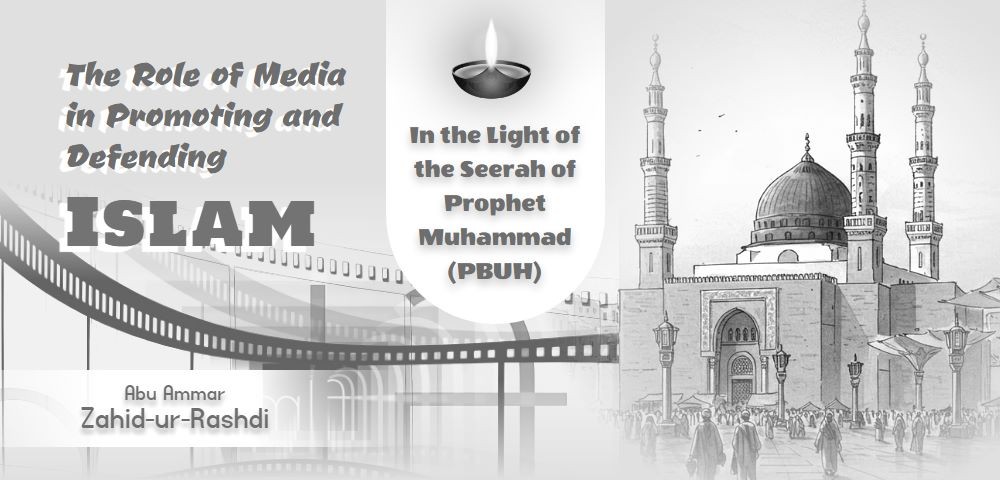
The Role of Media in Promoting and Defending Islam

In the present age, one of the greatest forms of struggle is the battle of ideas and communication. In every era, people have used the means available to them to spread their message, explain their beliefs, and convince others of their cause. Today, these means are called social media and mass communication platforms. The tools may have become modern, fast, and highly advanced, but the fundamental purpose remains the same: to convey one’s message, shape public opinion, and create an atmosphere in support of one’s mission.
This reality is not new. Even during the time of the Holy Prophet Muhammad (PBUH), communication and public influence played a vital role. History shows that after the Battle of Ahzab, when various Arab tribes united and marched against Madinah, the Muslims faced an extremely difficult situation. The Qur’an itself vividly describes that tense atmosphere, where fear surrounded the believers from all directions. Yet despite their strength and alliances, the attacking forces failed, and Allah returned them unsuccessful and frustrated.
After this major confrontation ended, the Prophet (PBUH) addressed his companions in Masjid an-Nabawi and made two important observations:
First, the Prophet (PBUH) explained that the military power of Quraysh had now weakened. The battles of Badr, Uhud, and Ahzab had broken their momentum, and they would no longer dare to launch large-scale attacks against the Muslims. From that point onward, the initiative would remain with the Muslims.
Second, the Prophet (PBUH) explained that when nations fail on the battlefield, they turn to another weapon: language and propaganda. This is part of human nature. When swords fail, words begin their work. He warned the companions that the opponents of Islam would now wage a war of speeches, poetry, public campaigns, and slander. They would travel to gatherings and marketplaces, spread propaganda, and try to turn people against Islam and the Muslims.
The Prophet (PBUH) then asked who would take responsibility for this battle of words. Four companions stepped forward: three poets — Hazrat Hassan bin Sabit, Hazrat Ka‘b bin Malik, and Hazrat Abdullah bin Rawahah, along with the eloquent speaker Hazrat Sabit bin Qais (may Allah be pleased with them all). Under the guidance and encouragement of the Prophet (PBUH), they defended Islam through speech and poetry. Their mission was to present the teachings and beauty of Islam, introduce people to the noble character of the Prophet (PBUH), answer false accusations, counter hostile propaganda, and clarify the truth with wisdom and eloquence.
One remarkable example comes from the occasion of Umrat-ul-Qaza. The Muslims had previously been prevented from performing Umrah at occasion of Hudaybiyyah, but according to the peace agreement, they returned the following year. Around fifteen hundred companions entered Makkah with the Prophet (PBUH) in the state of Ihram. Hazrat Abdullah bin Rawahah (RA) was leading the Prophet’s camel while saying passionate lines filled with courage and resolve. As the companions recited the Talbiyah, he chanted powerful lines that reflected strength and determination in front of Quraysh.
Hazrat Umar (RA), noticing this near the Ka‘bah, signaled to him to stop. But the Prophet (PBUH) intervened and told Umar (RA) to let him continue. The Prophet (PBUH) then made a profound statement: that these words were striking the hearts of the enemy more deeply than arrows. This showed that communication itself can become a battlefield, and words can carry immense power in defending truth and strengthening morale.
In that era, the main tools of influence were public speaking, poetry, marketplaces, and cultural fairs. The Prophet (PBUH) himself attended famous gatherings like the fair of Ukaz, where people from different tribes gathered for trade, poetry, and debate. Amid all the activities, he consistently presented the message of Islam. This demonstrates that using the means and language of one’s time to spread truth is not only permissible but essential.
Even today, Islam, the Muslim Ummah, and the teachings of the Quran and Sunnah face an onslaught from all sides. There are objections, slanders, insults, and a barrage of propaganda coming from every direction. There is a global storm surrounding Islam, the Holy Quran, the noble personality of the Holy Prophet (PBUH), Muslims, religious people, and Islamic centers. To answer this and establish our own front is the greatest need of today — but through strategy, wisdom, logic, and reasoning. It is my firm belief that if we can correctly present the teachings of the Quran and Sunnah in today’s style and modern language, and counter the opponents' objections, slanders, and propaganda with technique and wisdom, it would be a major Jihad, a monumental battle, and the ultimate need of our time. May Allah Almighty grant Islam, Muslims, and the Muslim Ummah the ability to serve well in this field, just as in other fields.
Translations
(الشریعہ — جون ۲۰۲۶ء)