

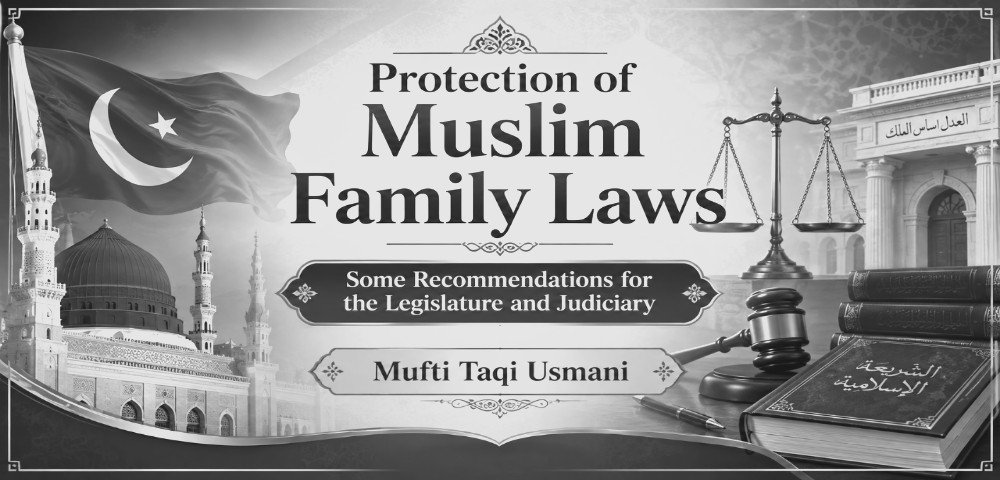
Protection of Muslim Family Laws
Some Recommendations for the Legislature and Judiciary

All praise is due to Allah, who brought this world into existence. And peace and blessings be upon His final Prophet, who raised the banner of truth in this world.
The rulings concerning marriage, divorce, bequests, and inheritance hold a degree of sanctity in every religion and community that is almost equal to that of acts of worship. That is why the Qur'an and Sunnah have elaborated upon these rulings in greater detail than any other legal matter, because these laws pertain to the family system, which is the cornerstone of any civilization—and upon this foundation, the edifice of a society is built.
When the British established their rule over the Indian subcontinent, they enforced their own laws in all matters. However, they retained the aforementioned laws as "Muslim Personal Law" and directed the courts to adjudicate such matters according to Hanafi or Ja'fari jurisprudence. Accordingly, in undivided India, courts remained bound by this directive. They would either rely on the fatwas of respected muftis or refer to books written on these subjects for interpretation and exposition of the Shariah. Although some court decisions contained errors, on the whole, the Muslim Personal Law remained largely preserved.
During this period, Hakim al-Ummat, Hazrat Maulana Ashraf Ali Thanvi (may Allah have mercy on him), observed that under Hanafi jurisprudence, certain women who were victims of oppression at the hands of their husbands, or who could not obtain separation due to their husbands' mental incapacity or disappearance, faced practical difficulties. Therefore, after consulting with the scholars of India, he issued a fatwa allowing such women to seek annulment of marriage under Maliki jurisprudence. Subsequently, this fatwa led to the enactment of the "Dissolution of Muslim Marriages Act," which was passed by the legislature and became a formal law. The merit of this law was that the oppressed wife's marriage would be annulled, and she would still retain her right to dower (mahr).
Pakistan's constitution has also acknowledged the importance of personal laws (Muslim Personal Law). In almost every matter, the right of all schools of thought (makatib-e-fikr) has been recognized, allowing them to continue to act according to their respective schools of thought in matters of marriage, divorce, and inheritance. All of Pakistan's constitutions, and ultimately the 1973 Constitution—which remains in force to this day—contains Article 227, which requires all laws to be brought into conformity with the Qur'an and Sunnah. This article also stipulates that in respect of the personal law of Muslims belonging to different schools of thought, the law applicable shall be that which is in accordance with the creed of that particular school.
Furthermore, Article 228 of the Constitution establishes an "Islamic Ideological Council" to recommend ways of bringing existing laws into conformity with Islamic principles. This council is composed of persons who are well-versed in the Qur'an and Sunnah and who represent various schools of thought, and whose role is to assist Parliament in legislation.
Article 203 established the Federal Shariat Court and a "Shariat Appellate Bench" of the Supreme Court for the purpose of determining whether a law is repugnant to the Qur'an and Sunnah. These bodies are empowered to hear, on a wide scale, the viewpoints of the government and the general Muslim public, and then render a considered and balanced verdict on the matter.
Even this authority is restricted by the condition that it cannot deliver any decision regarding Muslim Personal Law that is contrary to the tenets of any school of thought (maktab-e-fikr) of the Muslims. The Supreme Court's Shariat Appellate Bench interpreted this as follows:
"A law which a particular sect of the Muslims considers as its personal law based on its own interpretation of Holy Qur'ān and Sunnah is excluded from being scrutinised by the Federal Shariat Court under Article 203-D of the Constitution, as it would fall within the meaning of   'Muslim Personal Law'."
In other words, regarding marriage, divorce, and inheritance, every school of thought has its own personal law. Adherents of one school cannot be bound to follow the personal law of another school. For example, followers of the Shia school of thought cannot be forced to accept the rulings of the Sunni school, nor can Sunnis be forced to adhere to Shia jurisprudence.
This ruling was issued by the Shariat Appellate Bench, of which the author of these lines was also a member (see: Dr. Mahmood-ur-Rahman Faisal vs. Government of Pakistan, PLD 1994 Supreme Court, p. 207).
From this detailed explanation, it becomes clear that although our Constitution is unequivocal about bringing all laws into conformity with the Qur'an and Sunnah, it is particularly sensitive and protective regarding Personal Law.
Despite all these facts, it is regrettable that for some time now, our legislature and judiciary have exhibited an attitude of extreme negligence, specifically concerning Muslim Personal Law. When enacting any law regarding marriage, divorce, or inheritance, neither is it considered necessary to consult the Islamic Ideological Council, nor is any effort made to understand the positions of those who possess knowledge of the Qur'an and Sunnah. As a consequence of this approach, the Sindh government and the federal government declared marriage under the age of 18 years as illegal and imposed penalties for it. Furthermore, a single bench of the Islamabad High Court labeled such marriage as "zina bil-jabr" (rape by coercion) (PLD 2022 Islamabad, p. 228), without clarifying whether the marriage would remain valid after imposition of the penalty. This law has thus become mired in further ambiguity and uncertainty.
Similarly, the judiciary has been issuing one decision after another in such matters—concerning marriage, divorce, khul', dower, and so forth—where rulings are being given based merely on personal understanding, independent  of the Qur'an and Sunnah, and often contrary to the clear injunctions of the Shariah. It is a matter of deep regret that the understanding underlying these judgments is largely influenced by Western propaganda, which has already shaken the family system in the West. Before delivering such decisions, the necessity of hearing representatives from the various schools of thought on the relevant subject has also not been considered. In this manner, we have regressed in the matter of Muslim Personal Law, even falling behind the rights that Muslims enjoyed under British rule.
In our view, this conduct of the legislature and the judiciary is contrary to the overall scheme and the fundamental spirit of our Constitution, which safeguards Muslim Personal Law at every step.
We are submitting these recommendations with profound pain, heartfelt sincerity, and deep concern to the legislature and judiciary. Instead of making progress in implementing Islamic laws, the tendency to dismantle those laws that the Constitution itself has protected is pushing us backward from an Islamic perspective. For God's sake, abandon this approach, and wherever guidance from the Qur'an and Sunnah is required, refer these matters to the constitutional bodies—the Islamic Ideological Council, the Federal Shariat Court, and the Shariat Appellate Bench. And before taking any step on such issues, consult the scholars of all schools of thought at length.
In this matter, we also appeal to political parties and the legal community to remain vigilant in such cases. With the counsel of respected scholars, they should present the correct Shariah position before the legislature and judiciary in such cases.
It would be better to resolve this matter within the constitutional framework and to address it before it becomes a source of public protest and discord.
(Monthly Al-Balagh, Karachi – September 2026)

Translations

(الشریعہ — ستمبر ۲۰۲۶ء)

الشریعہ — ستمبر ۲۰۲۶ء

جلد ۳۷ ، شمارہ ۹

’’خطباتِ فتحیہ: احکام القرآن اور عصرِ حاضر‘‘ (۱۵)
مولانا ابوعمار زاہد الراشدی
مولانا ڈاکٹر محمد سعید عاطف

ابولہب کے لیے تخفیفِ عذاب کی روایت : تنقیدی جائزہ
ڈاکٹر محمد اکرم ندوی
ڈاکٹر فضل الرحمٰن محمود

امتِ مسلمہ کی تعمیر و تشکیل کا نبوی منہج (۲)
مولانا ڈاکٹر محمد ابوبکر فاروقی

محاضراتِ فقہ (۴)
ڈاکٹر محمود احمد غازیؒ

حنفی اصولی منہج (۵)
ڈاکٹر محمد مشتاق احمد

کیا قدیم علمِ کلام دورِ حاضر میں ایک  غیر متعلق روایت بن چکا ہے؟ (۹)
ڈاکٹر مفتی ذبیح اللہ مجددی

’’اسلام اور ارتقا: الغزالی اور جدید ارتقائی نظریات‘‘ کا جائزہ (۱۷)
ڈاکٹر شعیب احمد ملک
محمد یونس قاسمی

ہبہ، وصیت اور میراث کے شرعی احکام و ضوابط
مولانا مفتی عبد الرحمٰن منیر

غیر مسلموں کو سلام کہنے کا شرعی و فقہی جائزہ
مفتی سید انور شاہ

افواجِ پاکستان کا ترانہ
سید امین گیلانیؒ

6 ستمبر 1965ء  —    وقار اور لازوال استقلال کا استعارہ
مولانا محمد طارق نعمان گڑنگی

اسلام اور شخصی آزادی (۱)
ڈاکٹر محمد عمار خان ناصر
ذیشان ہاشم

ریاست کی ناکامی پرکھنے کے اصول اور کامیاب بنانے کے اقدامات
اسرار ایوب

پاکستان اور افغانستان کا ایک مستقبل
مولانا فضل الرحمٰن

سیمینار: امتِ مسلمہ کی حالتِ زار اور راہِ نجات
تنظیمِ اسلامی

سعودیہ، ترکیہ اور پاکستان کا مشترکہ دفاعی معاہدہ
الاحسان ٹی وی

کتبۂ مرقدِ محمودؒ کے مندرجات
ادارہ

ڈاکٹر محمود احمد غازی اور شریعہ اکیڈمی اسلام آباد
ڈاکٹر شہزاد اقبال شام

Protection of Muslim Family Laws
Mufti Taqi Usmani

۱۹۵۱ء کے بائیس دستوری نکات اور ۱۹۵۲ء کی دستوری سفارشات میں ترمیمات (۳)
حافظ مجددی

The Qadiani Question in State Appointments
Abu Ammar Zahid-ur-Rashdi

تلاش

شماریات